A quick industry breakdown for well tubulars:
2 critical components with completely different roles in well construction and production.
🔹 Casing (Permanent Well Structure)
Installed and cemented in the wellbore to support boreholes, isolate formations, protect freshwater zones, and act as the primary pressure barrier throughout drilling, completion and production. It is permanently fixed in the well.
🔹 Tubing (Production Flow Channel)
Run inside casing to provide a controlled flow path for oil, gas, water and injection fluids. Directly exposed to corrosion, scaling, internal pressure and workover operations. It is retrievable and replaceable.
📏 Basic Specs (API 5CT / ISO 11960)
✅ Casing: 4 1/2″ – 20″ | For well structural support
✅ Tubing: 1.05″ – 4 1/2″ | For fluid transmission
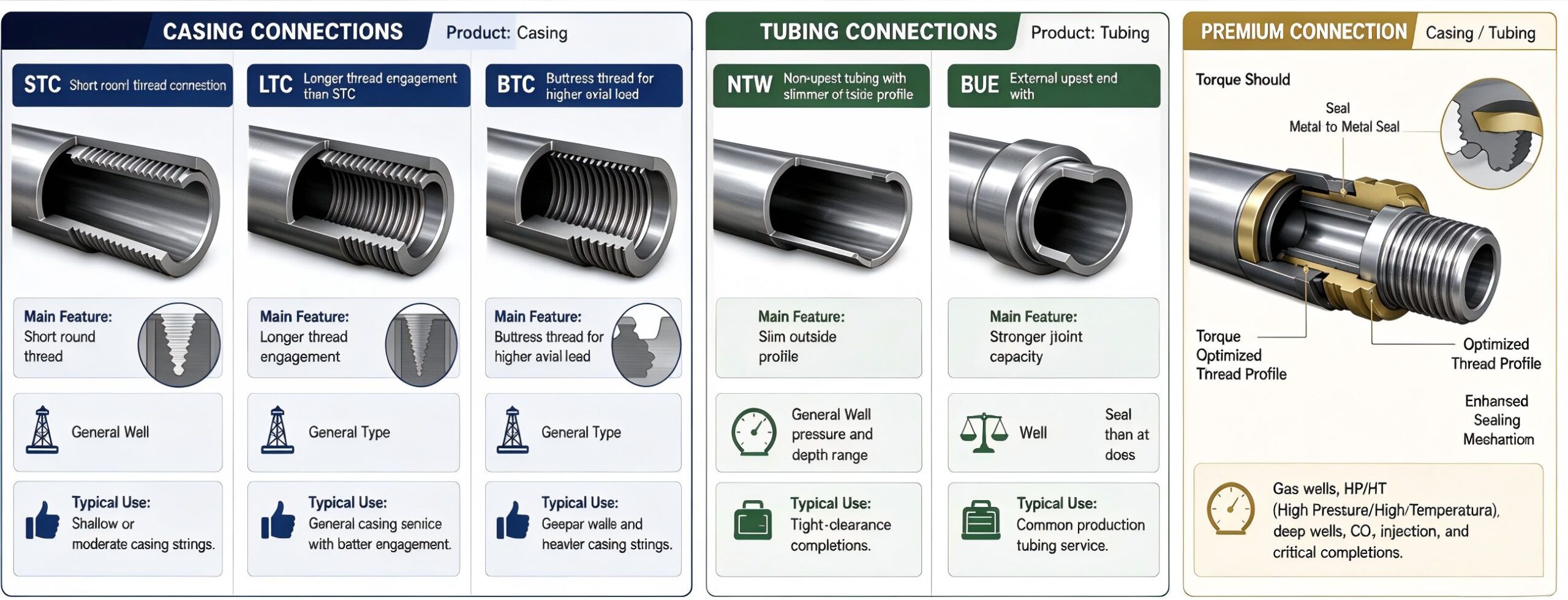
✅ Standard connections: STC, LTC, BTC, NU, EUE & premium connections
✅ Length Range: R1, R2, R3 or customized
⚙️ Grade Selection Guide by Well Condition
▫️ H40/J55/K55: Shallow wells & standard moderate-pressure operations
▫️ N80: Medium-deep wells with higher strength requirements
▫️ L80/C90/T95: Sour service & hardness-controlled well environments
▫️ P110/Q125: Deep & ultra-deep HTHP wells with heavy loads
▫️ 13Cr/Duplex/CRA: Corrosive wells (CO₂, chloride & sour conditions)
Key takeaway:Proper selection of tubular grade, connection type and material is essential for well stability, operational safety and long-term service life.